Pump.fun launched on January 19, 2024 with a simple pitch: anyone can create a token in a minute, for about nothing, and it trades immediately. No liquidity to seed, no pool to set up, no code. By mid-2026 it had processed something like 12 million token launches and earned, by its own numbers, well over $800 million in fees. It is the most used application on Solana and probably the most used consumer app in crypto.
It is also widely misunderstood, including by people who use it every day. This is how the pieces fit.
The bonding curve
When you create a token on Pump.fun, no liquidity pool is created. Instead, the token trades against a formula. Every token gets a supply of one billion. About 793 million of those are available to buy from the curve; the remaining 207 million are set aside for the pool that will exist later.
The formula is the same constant-product rule that AMMs use, x times y equals k, but applied to virtual reserves rather than real ones. The curve starts with 30 virtual SOL and about 1.07 billion virtual tokens. That starting ratio sets the opening price, which is why every new Pump.fun token starts at roughly the same tiny market cap. Each buy removes tokens from the curve and adds SOL, which pushes the price up. Each sell does the reverse.
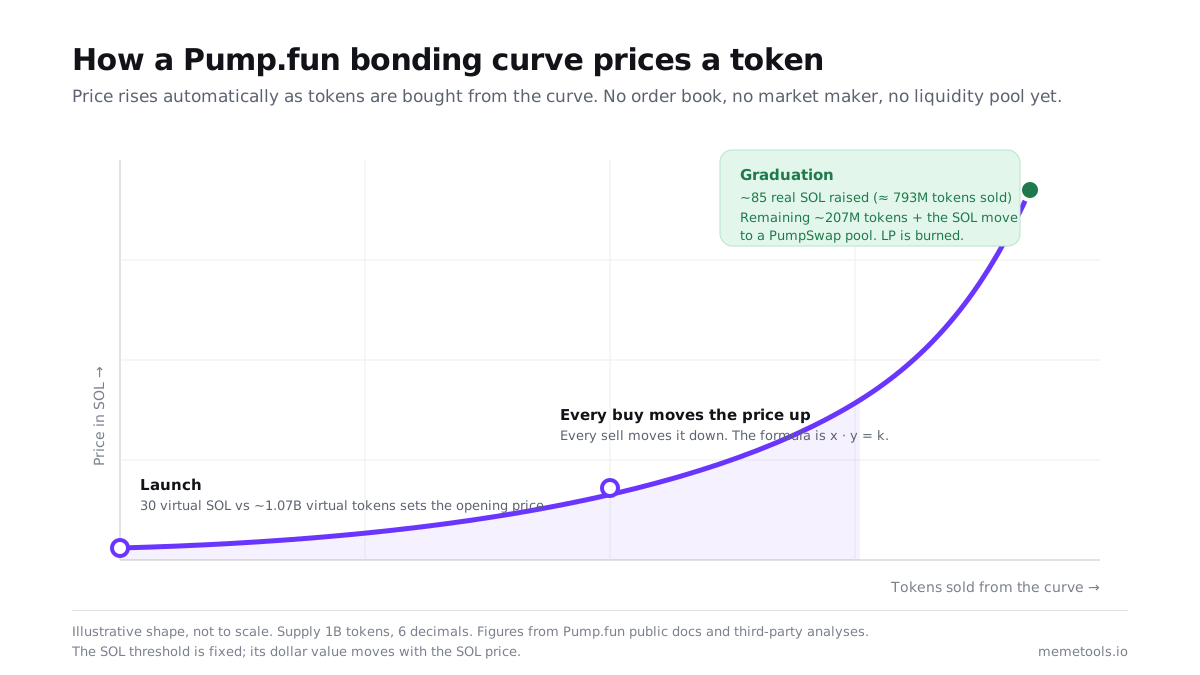
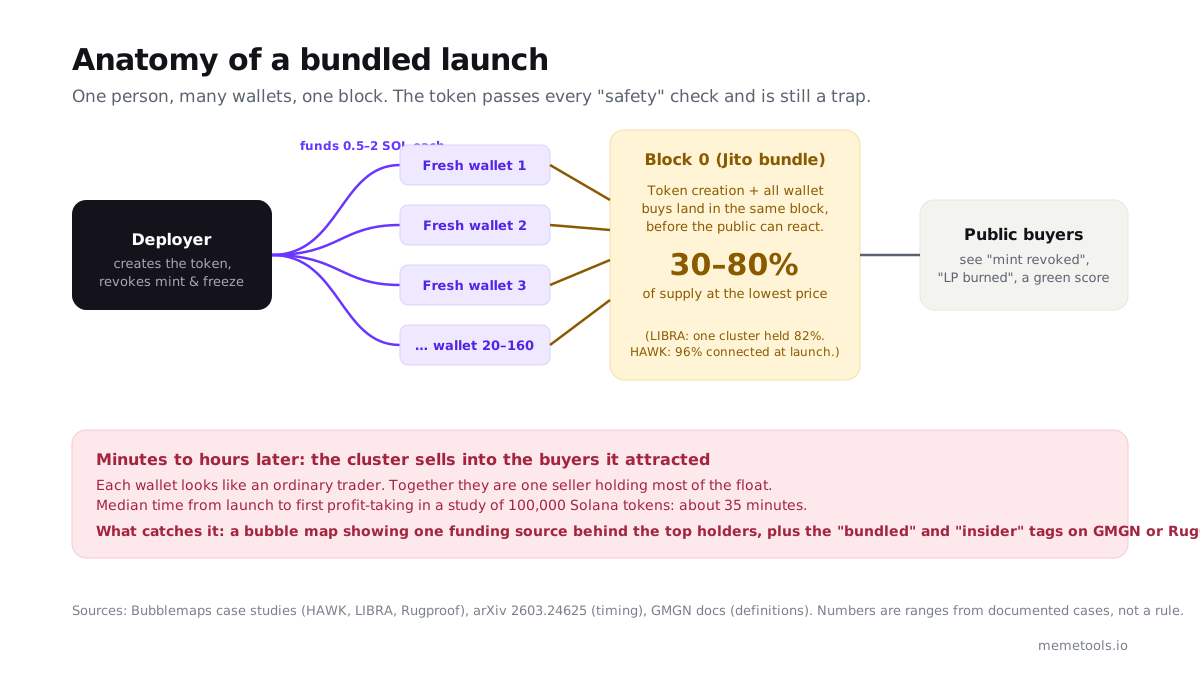
Because the counterparty is math, a bonding curve token can’t be hard-rugged in the traditional sense. There’s no pool for the creator to drain. What it can be is dumped. If the creator and friends bought 40% of the supply in the first block, the curve will happily let them sell it back into every buyer who arrives after.
Graduation
Once the curve has collected about 85 real SOL, the token “graduates”. The SOL and the remaining 207 million tokens are moved into a liquidity pool, the LP tokens are burned, and from then on the token trades like any other Solana token. Until March 2025 that pool was on Raydium and the migration cost 6 SOL. Since then Pump.fun migrates tokens to its own DEX, PumpSwap, with no migration fee.
People quote the graduation threshold as “$69,000 market cap”. That was true at a particular SOL price in 2024. The threshold is denominated in SOL, so the dollar figure drifts. What doesn’t change is the shape: a token needs real buyers to put in roughly 85 SOL before it gets a real market.
Most never do. Over the platform’s life, somewhere between 1% and 2% of launches have graduated. The rate has been falling as launch counts rise: around 0.84% in April 2026, and one analysis citing Dune data put it near 0.26% in June. Only 96 tokens in the platform’s history have ever passed a $1 million market cap, and 18 have passed $10 million. Roughly a quarter of graduations are themselves bot-driven, meaning bots bought the token up the curve to get it listed.
What it costs
Creating a token is effectively free. The first buy, which is usually the creator’s own, pays network costs of around 0.02 SOL. Trading is where the fees live, and the fee schedule has changed three times.
| Period | Trading fee on the curve | Creator share |
|---|---|---|
| Jan 2024 – May 2025 | 1% flat to the protocol | None |
| May 12, 2025 onward | 1% total | Creator fees introduced |
| Sept 2025 onward (“Project Ascend”) | 1.25% total | 0.30%, rising to 0.95% at larger caps |
The current model, which Pump.fun called Project Ascend when it went live in early September 2025, is tiered by market cap. On the curve and on small-cap PumpSwap pools the total fee is 1.25%, with 0.30% to the creator and most of the rest to the protocol. Above a market cap of about 420 SOL the creator share climbs toward 0.95% while the protocol take falls, and at very large caps the total fee falls to around 0.30%. Non-canonical pools on other DEXs charge 0.30% with nothing to the creator.
In January 2026 Pump.fun added fee sharing, so a creator can split revenue across up to ten wallets, and transfers, so the creator role can be handed off. A “cashback” mode for traders came and went; a “Holder Rewards” variant replaced it in 2026. The exact numbers move around and stale guides still quote the old flat 1%, so check the public docs repository before you rely on a figure.
Where the money goes
Pump.fun’s revenue peaked at more than $14 million in a single day on January 2, 2025, and the whole of that month brought in somewhere around $130 million. It bottomed at $206,000 a day on August 1, 2025, then recovered to $3.38 million a day by mid-September, enough to top Hyperliquid for a day. Through 2026 it has run between roughly $1.3 and $2.5 million a day, and by Q3 2026 it accounted for about 40% of all application revenue on Solana.
In July 2025 the company sold a token. The PUMP sale raised about $500 million from the public in twelve minutes at $0.004 per token, a $4 billion fully diluted valuation, on top of a private round that took the total raise to around $1.2 billion. US and UK residents were excluded. Since then the company has been buying the token back: 25% of revenue at first, then 100%, with $97.4 million repurchased by mid-September 2025. In April 2026 it burned roughly $370 million worth of accumulated PUMP and committed half of net revenue to buybacks for the following year.
The abuse that comes with the territory
A permissionless launchpad with a predictable price curve is an invitation. The main patterns:
- Bundling. The creator funds a stack of wallets and buys in the same block as the launch, before anyone else can. Dozens of third-party tools exist to do this. One academic sample found bundled accounts holding about 36% of supply at launch on average.
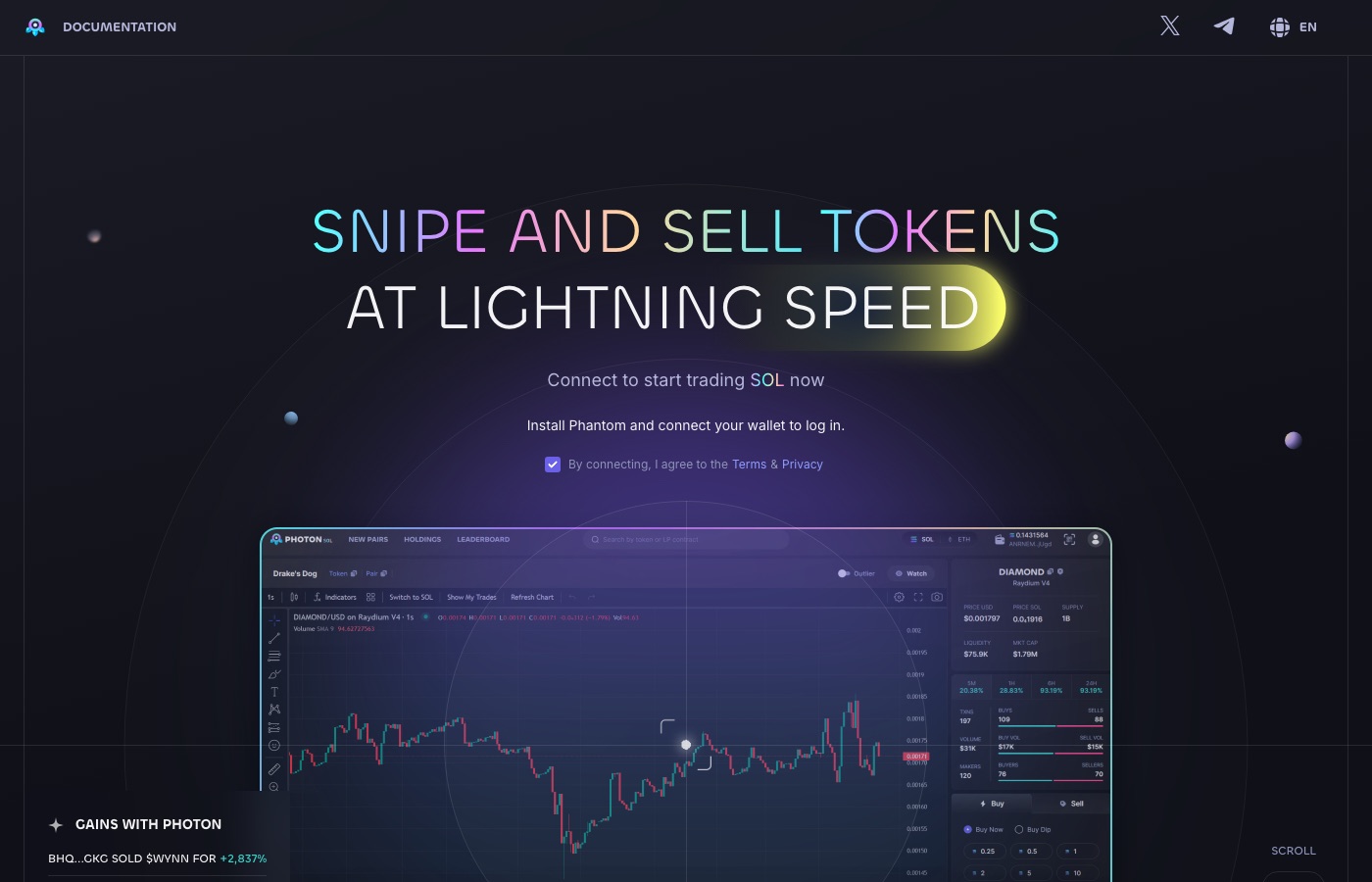
- Sniping. Bots buy every new launch in its first blocks and sell within minutes. A 2025 analysis found more than half of tokens were sniped in the creation block, mostly by spray-and-pray bots, and deployer-funded snipers profitable 87% of the time.
- Volume bots. Bitquery documented one operator seeding 200 bots with half a SOL each to fake $500,000 of volume in twelve hours, enough to push a token up trending lists.
- The graduation dump. Bots walk a token up the curve, it graduates, the chart looks real, retail arrives, the bots sell.
Solidus Labs put a number on it in May 2025: 98.6% of Pump.fun tokens with at least five trades ended up as pump-and-dumps, defined as liquidity under $1,000. Pump.fun’s spokesman replied that Solidus “lacks a basic understanding of memecoins”. Both things can be true. The report measured failure, not fraud, and most tokens on a free launchpad are going to fail. But the gap between “most fail” and “98.6% fail” is where the bundlers and bots live.
Pump.fun’s own answer has been tooling rather than restrictions. Its InsightX integration and Bubblemaps surface clusters, and PumpSwap pools burn LP at graduation. It has not stopped bundling at the protocol level, and it’s hard to see how it could without breaking the permissionless part.
The legal side
A class action filed in the Southern District of New York in January 2025 accuses Baton Corp, the company behind Pump.fun, and its founders of running an unregistered securities operation. An amended complaint in July 2025 added racketeering claims and named Solana Labs, the Solana Foundation and Jito. Jito was dropped in September. Reports differ on where the RICO claims stand as of late 2026, with the plaintiffs’ firm saying they were allowed to proceed and another report saying they were rejected, so check the docket before repeating either.
In the UK, the FCA issued a warning in December 2024 and Pump.fun blocked UK users itself within days. The livestream feature was shut down in November 2024 after streamers used it for stunts that included threatening pets, and brought back gradually in 2025 with more moderation.
The competition
Pump.fun’s model has been cloned on every chain. LetsBonk on Solana briefly passed it on daily launches in July 2025, with a similar 85 SOL threshold and graduation to Raydium. Believe, Moonshot and Boop all tried creator-reward variations; by late 2026 several of them were quiet or offline. Zora on Base skips the curve and puts tokens straight into a Uniswap pool with half the fee to the creator. Four.meme is the BNB Chain equivalent. In September 2026 Pump.fun added Custom Pairs, which lets tokens launch against tokenized stocks instead of SOL, and that category quickly became the largest source of new volume on the platform.
What this means if you trade it
- Before graduation there is no LP to rug, but there is supply to dump. Check the holder map, not the authorities.
- Graduation is a liquidity event for whoever bought low on the curve. Expect selling right after.
- The fee you pay is 1.25% on the curve, not 1%. On a round trip that is 2.5% plus network and terminal fees.
- Launch count is not a health metric. 35,000 launches a day with a 0.5% graduation rate is 175 real markets and 34,825 dead tokens.