Chainalysis counted about $713 million stolen from personal wallets in 2025 across 158,000 incidents. Solana had more of those incidents than any other chain, roughly 26,500 victims, though a lower rate per wallet than Ethereum or Tron. Almost none of that was a technical compromise of a wallet app. It was people handing over seed phrases, signing transactions they didn’t read, and copying the wrong address.
That is good news in one sense. The threats are boring and the defenses are boring too. This guide covers how wallets actually get drained on Solana, what Phantom and Solflare do about it, and the setup that keeps a memecoin habit from costing you your main stack.
How Solana wallets actually get emptied
Nobody publishes a ranked list, so this order is our judgment from incident reports. It goes roughly from most common to least.
- Seed phrase phishing. Fake support accounts that DM first, fake Phantom sites, “claim” links, and wallets set up from a phrase someone else gave you. The newer trick, flagged by Scam Sniffer in February 2025, connects to your real Phantom, pops a fake “update extension” prompt, then asks for your seed to “restore”.
- Drainer dApps. A fake airdrop, mint or claim page. The transaction you approve does the damage. Signing a message can’t move funds on its own; approving a transaction can.
- Account ownership takeover. A signed transaction uses the System Program’s assign instruction to hand your account to the attacker’s program. The preview can show no balance change. SlowMist tracked more than $3 million lost this way in December 2025 alone.
- Token delegates. A dApp you used once was granted permission to spend a token on your behalf. Disconnecting doesn’t revoke it.
- Address poisoning. Lookalike addresses sent as dust so you copy the wrong one from history. One case in November 2024 cost $2.9 million; a smaller one in November 2025 cost $30,750 after a $10 “test” to the fake address went through.
- Telegram bots that hold your key. Banana Gun lost $3 million across eleven users in 2024 through a bug, not phishing. The bot was the wallet.
- Fake extensions. Firefox add-ons impersonating Solflare and TronLink were caught logging seed phrases in August 2025.
- Durable nonces. A transaction signed today that stays valid until someone chooses to execute it. Simulation only checks the moment you sign. The $285 million Drift exploit in April 2026 used pre-signed transactions, though that was a protocol multisig, not a retail drain.
- Plain key exposure. Private keys in screenshots, cloud notes and clipboard managers. SlowMist put key leaks as the top cause of loss across all chains in Q3 2025.
What Phantom does about it
Phantom runs several layers, and it pays to know what each one actually says so you recognize it under pressure.
- The domain blocklist. Open source on GitHub, a list of known phishing domains that the extension checks locally. Anyone can submit a domain by pull request and new entries reach users within about fifteen minutes. If you land on a listed site you get a full-page warning. You can click through it. Don’t.
- The new-domain warning: “This domain is new or has not been reviewed yet. Proceed with caution.” It clears on its own after a few days. It is not an accusation; it is a prompt to slow down.
- Transaction simulation. Phantom previews what a transaction will do before you sign. The engine came from Blowfish, which Phantom incubated and then acquired in November 2024. It flags blacklisted programs, suspicious authority changes, dangling approvals, lookalike domains and suspicious tokens.
- The simulation warning: “This dApp could be malicious. Do not proceed unless you are certain it is safe.” It appears when Phantom can’t simulate the outcome accurately. Legitimate apps trigger it sometimes. Drainers trigger it a lot. If you see it on a site you found an hour ago, the answer is no.
- Spam handling: hide or burn junk NFTs, and the burn returns the rent deposit.
Phantom Support will never ask for your Secret Recovery Phrase. Ever.
Phantom help center
Solflare simulates too, and has one warning worth memorizing because it names the delegate problem directly: “Signing this transaction will allow your funds to be spent at a future date without your approval.” If you see that on a memecoin site, it is setting a delegate on your tokens. Backpack’s documentation on this is thin enough that we couldn’t describe its behavior with confidence.
The three-wallet setup
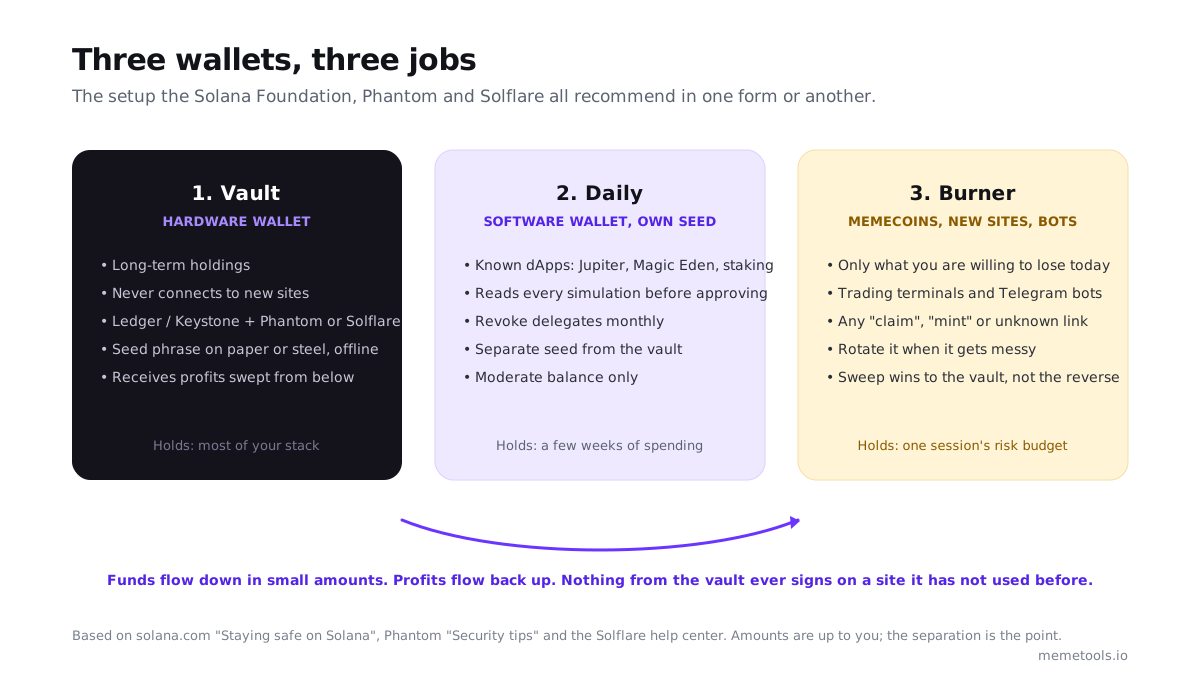
The Solana Foundation recommends separate main, daily and test wallets. Solflare recommends a separate wallet with a small balance and its own recovery phrase for unknown dApps. Phantom calls it separate accounts for holdings and app interactions. Same idea.
- The vault is a hardware wallet. Ledger works with both Phantom and Solflare. It holds the stack and it never connects to a new site. Its seed lives on paper or steel, offline.
- The daily wallet is a normal software wallet with its own seed. Jupiter, Magic Eden, staking, the apps you already trust. Moderate balance. You read every simulation.
- The burner is for memecoins, terminals, Telegram bots and any link you’re not sure about. It holds what you’re willing to lose today. When it gets cluttered with dust and dead tokens, you make a new one.
The rule that makes it work: funds go down the chain in small amounts and profits come back up. The vault never signs on anything the burner hasn’t already survived.
Hardware wallets and blind signing
A Ledger protects the key. It doesn’t fully protect you from what you sign, because most Solana program instructions can’t be decoded on the device screen. Using Phantom with a Ledger requires enabling blind signing in the Solana app on the device, and Phantom’s own docs say some transactions require it. In practice that means the Ledger confirms that you are the one signing, and Phantom’s simulation is still what tells you what you’re signing. Use both. And never type the Ledger’s recovery phrase into Phantom or anywhere else; a hardware wallet that asks you to is a fake.
Delegates: the permission you forgot you gave
On Solana, each token account can have one delegate with a spending limit. Approving a swap on a sketchy site, or signing the wrong thing on a “claim” page, can set that delegate to an attacker. Disconnecting the site in your wallet does nothing to it. The delegate stays until you revoke it.
Phantom’s help center points to Famous Fox Revoker, which has a revoke-all button. Sol Incinerator has a revoke tool, and Revoke.cash reportedly supports Solana now. Revoking is cheap and takes a minute, so do it monthly and after any session on a site you didn’t fully trust. What revoking can’t do: undo a transfer that already happened, restore an account whose owner was reassigned, or override a Token-2022 permanent delegate baked into the token itself.
While you’re in there, you can close empty token accounts to reclaim about 0.002 SOL of rent each. Sol Incinerator and the burn tools Phantom lists do this. Only close accounts that are already empty, and only burn tokens you’ve confirmed are worthless, because that part is permanent.
Address hygiene
Address poisoning works because Solana addresses are long and people check the first four and last four characters. Attackers generate addresses matching exactly those, send you dust, and wait. Bitquery found about 4.5 million Solana wallets had been targeted over eleven months to October 2026.
- Save real addresses in your wallet’s contacts and copy from there. Never from transaction history.
- Check the middle of the address, not just the ends.
- A small incoming transfer from an address you don’t recognize is the attack, not a gift.
- A successful $10 test proves nothing if you sent the test to the attacker.
The rules, short enough to remember
- The seed phrase goes in a wallet you installed from the official store, and nowhere else, ever. Not support, not an “update”, not a recovery form.
- Nothing you reach from a DM, a reply or a sponsored search result gets a signature. Type the URL.
- Read the simulation. A “could be malicious” warning on a new site is a no.
- Three wallets. The vault never meets a new site.
- Revoke delegates monthly. Rotate the burner when it gets messy.
- Copy addresses from contacts. Check the middle.
- A bot that generates your wallet is a hot wallet. Export the key if it lets you, and keep one session’s money in it.
None of this requires expertise. It requires doing the boring thing every time, including the time you’re in a hurry because a token is moving. That is exactly the moment the scam is designed for.