A memecoin terminal is a trading interface built for tokens that didn’t exist an hour ago. It shows you new launches as they happen, lets you buy with one click, and charges a percentage for the privilege. In 2024 Photon owned this market. In 2025 Axiom took it. In 2026 the picture shifted again, and two of the names people still recommend are either gone or wounded.
This is a comparison of what these tools actually do, what they cost, and what they ask you to trust. Everything here is from official docs where we could read them and from independent data where we couldn’t. Where a figure came only from a review site with an affiliate link, we’ve said so or left it out.
The short version
| Terminal | Form | Fee per trade | Keys | Status, Oct 2026 |
|---|---|---|---|---|
| Axiom | Web (perps via Hyperliquid) | 1%, down to 0.75% with volume | Non-custodial via Turnkey | Still the revenue leader; lost the volume lead to FOMO in August |
| Photon | Web | 1% flat | Key shown once at signup, exportable | Operating, ~1% share, far below its 2025 peak |
| GMGN | Web + Telegram | 1% | Generated wallet or connect Phantom | Growing, record fee quarter; multichain |
| Trojan | Telegram + web | 1% with 20% cashback | Generated, encrypted, exportable | Operating |
| Terminal (ex-Padre) | Web PWA | ~1%, referral cashback | Non-custodial via Turnkey | Acquired by Pump.fun Oct 2025 |
| BullX | Web + Telegram | 1% flat | Unclear | Trading suspended June 1, 2026; no relaunch |
| Nova | Telegram | 1% | Dedicated trading wallet | Operating; unconfirmed $500K+ user drain in Sept 2025 |
What the fee buys
Every terminal here charges about 1% of each trade, on both the buy and the sell. On a $1,000 round trip that is roughly $20 before anything else. Axiom’s volume tiers bring it down to $15 at the top tier. Trojan’s 20% cashback makes it about $16. The “0.5%” figures you see on some comparison sites don’t match any official fee page we could find.
The percentage isn’t the whole cost. On top of it you pay Solana’s base fee, a priority fee to validators for faster inclusion, and in most terminals a “bribe” or Jito tip to block builders to land your transaction ahead of the bots. Axiom’s defaults are 0.001 SOL for each; GMGN’s minimums are 0.0001 SOL with a combined cap of 2 SOL. Those go to the network, not the terminal, and the terminal’s docs will tell you, in Axiom’s words, that a bribe is “NOT 100% effective”. Failed transactions still pay the base fee.
Axiom
Axiom is a web terminal that went from launch to the top of the Solana volume charts in a matter of months in early 2025, peaking at about $101 million in daily volume that April. Its discovery feed, Pulse, shows new pairs, migrations and about-to-graduate tokens in three columns, and the rest of the product is what you’d expect: limit orders, wallet tracking, a Twitter monitor, multi-wallet management, and perps routed to Hyperliquid.
The fee is 1% gross, paid in SOL, with cashback tiers by cumulative volume that take the net rate down to 0.95%, 0.90% and eventually 0.75%. There are three MEV modes: off, reduced (through Jito, some exposure remains) and secure (slower, whitelisted validators). Wallets are non-custodial through Turnkey, an embedded-wallet provider. The docs we read don’t describe key export, which is the one thing we’d want to confirm before putting serious money in.
Two things happened to Axiom in 2026. In August, FOMO, a self-custodial social trading app, passed it on daily Solana spot volume, and by late August Blockworks data had FOMO near 46% share with Axiom under 30%. Axiom still makes far more money: about $27 million in fees over the 30 days to mid-August against Photon’s $0.6 million, and $737 million all-time. The other thing was uglier. In February, the investigator ZachXBT alleged that an Axiom employee had used internal dashboards to look up user wallets and front-run their trades. Axiom said it removed the employee’s tool access and was investigating. We found no public conclusion. It is a reminder that “non-custodial” says who can move your funds, not who can see your orders.
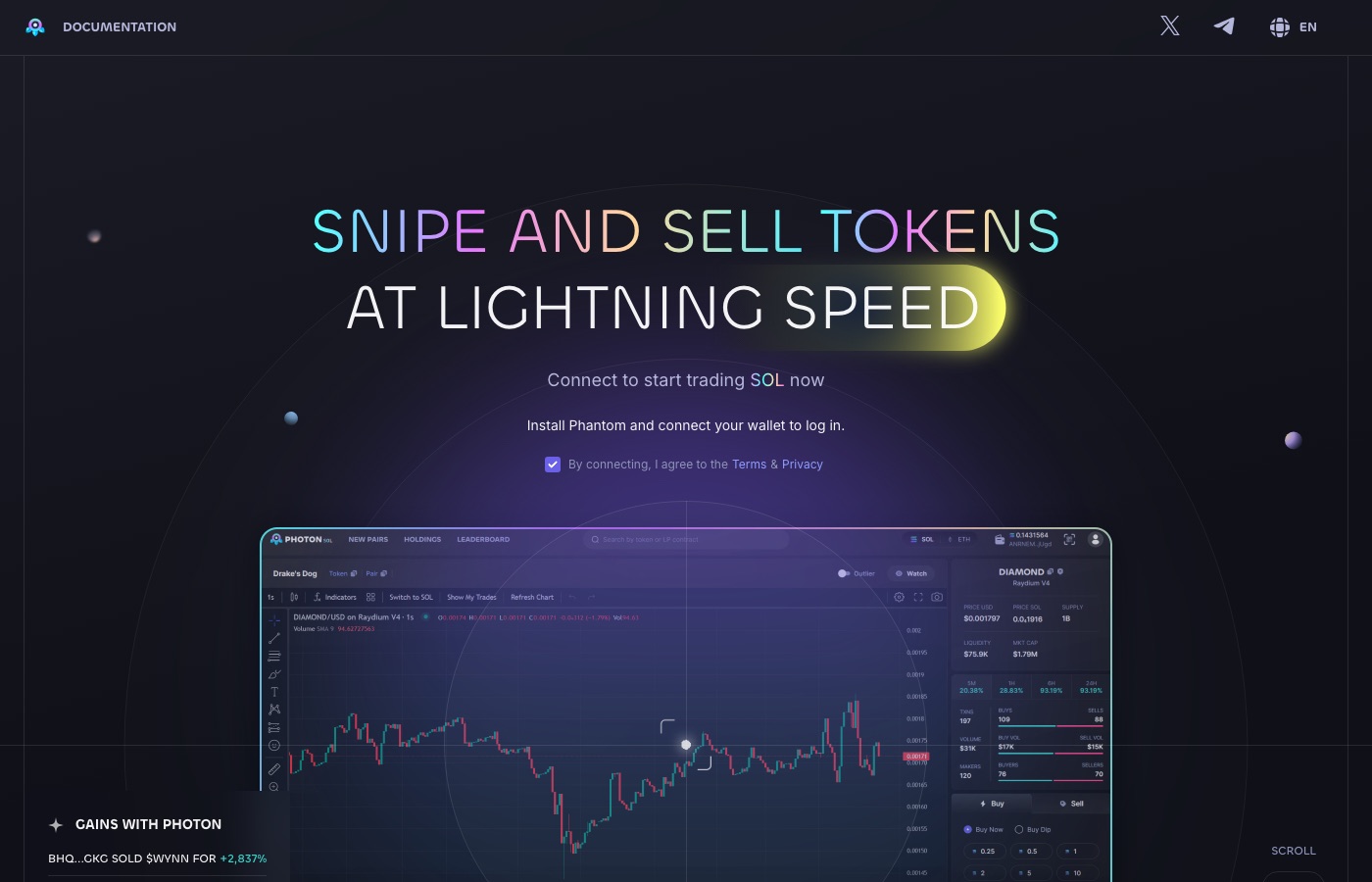
Photon
Photon was the default Solana terminal of the 2024 cycle, pulling $84.6 million in fees in January 2025 alone. By August 2026 its monthly fees were about half a million dollars and its share of Solana spot volume about 1.3%. It still works, and some traders prefer its simpler layout and Memescope screener, but the network effect left with the volume.
The fee is 1% flat with no published way to reduce it. Photon creates a wallet at signup and shows you the private key once, which you can import into Phantom. It supports limit and DCA orders and up to five wallets, but no copy trading, wallet tracking or perps. There has been no documented hack of Photon itself. There has been a steady stream of lookalike domains running drainers, so type the URL.
GMGN
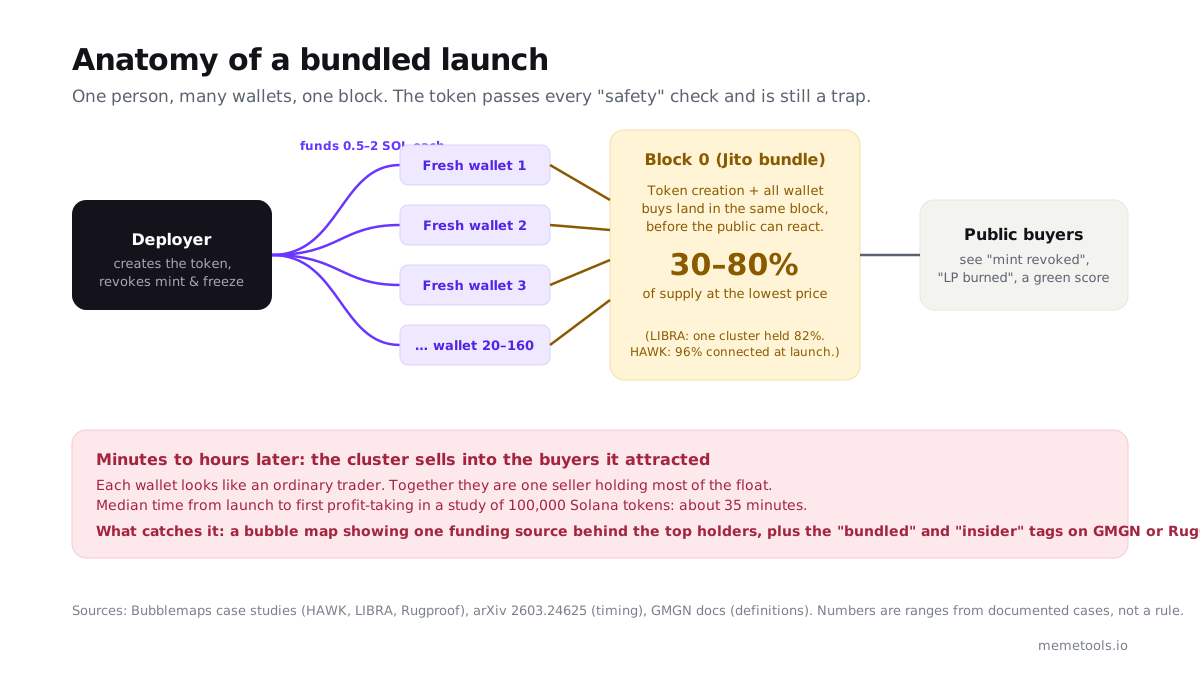
GMGN started as a wallet-tracking tool and grew into a terminal, which shows in what it’s good at. Every token page tags the wallets trading it: snipers, insiders, suspected insiders sharing a funding source, bundled buyers, the dev. It shows whether the dev has sold and the creator’s rug history. That labeling is the reason most people open it even if they trade elsewhere. It also offers copy trading with up to ten tasks, take-profit and stop-loss, and a sniping module.
It runs on at least seven chains and the fee is 1% everywhere, with up to 30% of it going to whoever referred you. Anti-MEV mode requires a minimum 0.002 SOL priority fee. The Telegram login generates Solana, EVM and Tron wallets; one sponsored explainer claims those generated keys can’t be exported, which we couldn’t confirm from official docs. You can connect Phantom instead and sidestep the question.
GMGN’s revenue has grown through the year to a record quarter of around $64 million to early September, with Robinhood Chain reportedly about half of it during the August memecoin migration. In October 2025 a fake third-party token site tricked about 107 GMGN users into signing malicious transactions for more than $700,000; GMGN said its own systems weren’t breached and it would compensate users.
Trojan
Trojan is the Telegram-first option, with a web interface added later. The official docs put the fee at 1% with 20% cashback, charged only on successful swaps. Third-party reviews quote 0.9% and tiered cashback up to 45%, which don’t match the official page, so believe the official page. Sniping, copy trading and limit orders are reported by reviewers; the docs we read don’t detail them.
On keys, Trojan is unusually clear. Its docs say the generated wallet’s key is encrypted, that nobody at Trojan can access it, that you can view and export it, and, in its own words, to “always treat your wallet as a hot wallet”. That’s the right advice for every tool on this list. No public exploit of Trojan has been reported.
The others
- Terminal, formerly Padre: Pump.fun bought Padre on October 24, 2025 and renamed it. The PADRE token was discontinued and fell more than 76%. It runs as a web app across Solana, Ethereum, Base and BNB, with a roughly 1% fee and referral cashback, Turnkey wallets with per-wallet key export, and no perps. It had about 7.7% of Solana spot volume in June data.
- BullX: trading was disabled in the app on June 1, 2026. Withdrawals and wallet access stayed open. As of late September no relaunch had been announced and the long-promised BULLX airdrop never happened. If you have funds there, the only sensible action is to get them out.
- Nova: Solana-only Telegram bot, 1% fee, sniping and copy trading, up to ten wallets. In September 2025 a user reported a drain of more than $500,000; the cause was never confirmed publicly. Treat it accordingly.
- FOMO: not a terminal in the traditional sense, but a self-custodial social trading app that overtook Axiom on volume in August 2026 and added Hyperliquid perps in June. Worth knowing about if only because it’s where the volume went.
The question that matters more than fees
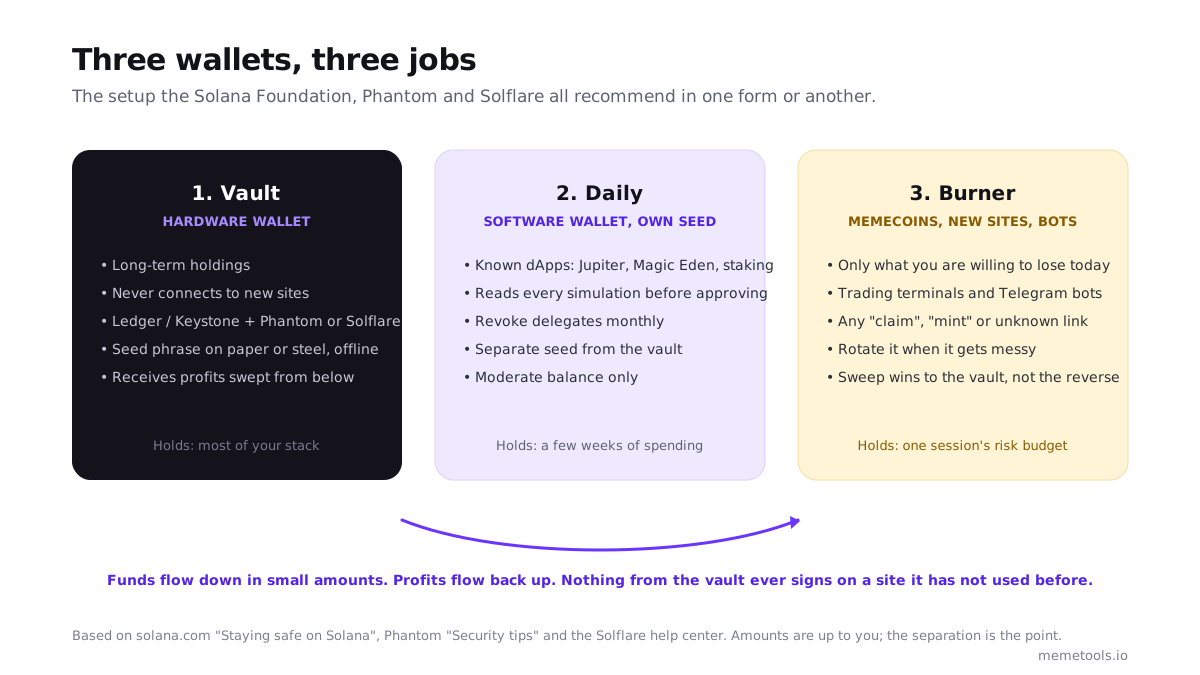
Every terminal on this list except Axiom, Terminal and GMGN-with-Phantom generates a wallet for you. That is the only way to get one-click trades without a signature popup, and it means the app can sign on your behalf. The differences worth caring about are whether you can export the key, and who else can read it. Photon shows it once. Trojan and Terminal let you export any time. GMGN’s generated wallet may not allow export at all. BullX left users with a frozen app and unverified exit paths.
The history of Telegram bots is the history of that risk going wrong: Maestro lost about $500,000 in October 2023 and refunded it. Unibot lost about $640,000 days later through a router bug. Solareum lost $523,000 in April 2024 and shut down. Banana Gun lost about $3 million across eleven users in September 2024. None of those were phishing. The product was the hole.
The Axiom episode adds a different lesson. Non-custodial infrastructure stops employees moving your money. It doesn’t stop them watching your trades if the dashboards let them.
How we’d choose
- For reading a token before buying it: GMGN, for the wallet tags, even if you trade somewhere else.
- For speed and the deepest feature set on Solana: Axiom, with the caveat about key export and the February incident.
- If you want your own wallet in control: connect Phantom to GMGN, or use a terminal that documents key export.
- For Telegram: Trojan, mainly because it is honest about what a generated wallet is.
- Whatever you pick, fund it with one session’s risk, export the key where you can, and type the URL every time.