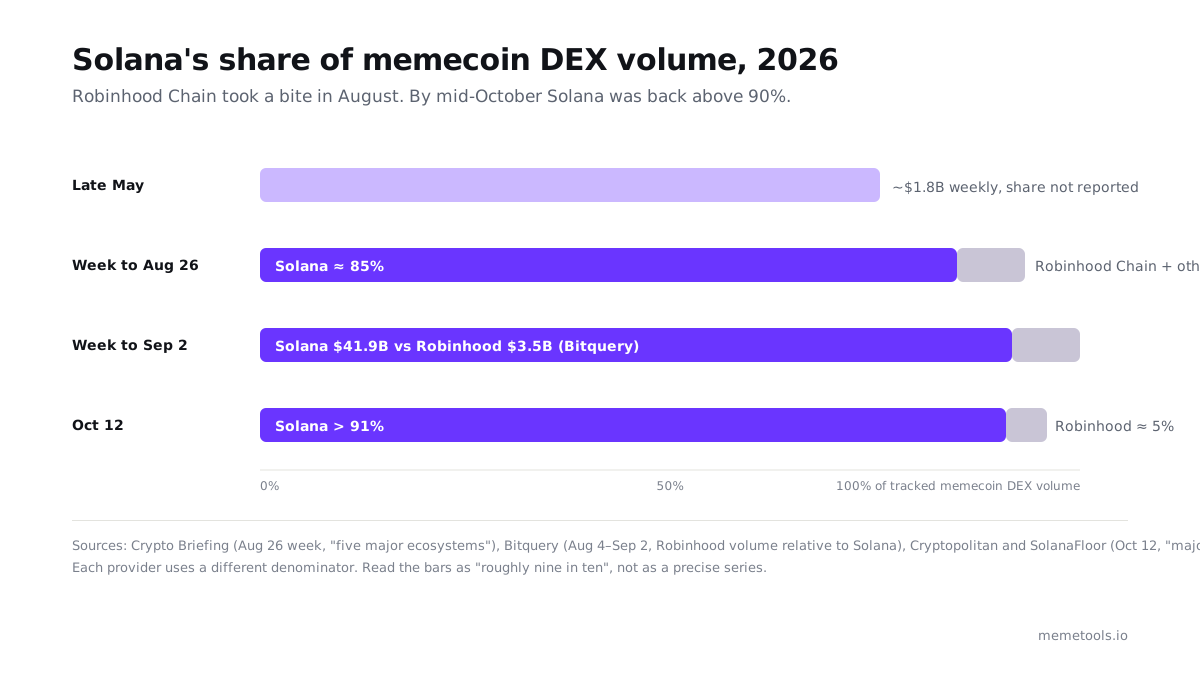
In the second week of October a chart made the rounds showing Solana handling more than 91% of memecoin trading across major decentralized exchanges, its highest share in fourteen weeks. The story attached to it was simple: Robinhood’s new chain had tried to take the memecoin crowd in August, briefly succeeded, and lost them again.
That version is roughly right. The details are more interesting than the summary, and the numbers underneath are shakier than the confidence with which they were reported.
What happened in August
Robinhood Chain, an Ethereum layer-2 built on Arbitrum tech, went live on July 1. It was designed for tokenized stocks. Within a week Pump.fun had added support for it, and Robinhood’s CEO Vlad Tenev was calling the chain “great for memes”. On August 12 a bonding-curve launchpad called Pons appeared on the chain and the memecoin traders followed.
For a few weeks it looked like a real migration. Bitquery, which has the best public methodology on this, tracked Robinhood Chain memecoin volume growing from $1.4 billion in the first week of August to $3.5 billion in the last. Measured against Solana, Robinhood went from about 3% of Solana’s meme volume to about 8%. Pons alone did roughly $360 million between August 12 and 31. A token called CASHCAT went from a few million to a $140 million market cap within hours of a Tenev tweet.
The thing that got lost in the “Solana is losing” takes: Solana’s own memecoin volume didn’t fall. Over the same four weeks it went from $40.7 billion to $41.9 billion. Solana lost share. It didn’t lose traders. Robinhood Chain added a new pool of activity on top, and that pool was notably different in character. The median Robinhood wallet traded about $189 against $7 on Solana, and the top 1% of wallets drove 62% of Robinhood volume versus 97.5% on Solana. Fewer bots, more humans, smaller totals.
Why the money came back
Partly because Robinhood Chain’s memecoin scene was thinner than it looked. Bitquery flagged one bot cluster that created about 182,000 tokens in eight days. Partly because Solana’s infrastructure for this is years ahead: the terminals, the sniping tools, the wallet trackers and the liquidity are all here. And partly because Pump.fun changed the game again.
On September 9, Pump.fun launched Custom Pairs, letting creators launch memecoins paired against tokenized stocks instead of SOL. By the week ending October 11, those pairs were doing $125 million of a $216 million weekly market, a 58% share. Blockworks tracked $5.58 billion of tokenized-stock DEX volume on Solana between September 1 and October 11, and $1.76 billion of it, nearly a third, was memecoins paired with stocks. About four-fifths of that came from one launchpad, StonkFun.
So the October rebound isn’t WIF and BONK having a moment. The established coins were red. In the first week of October, CoinGecko had TRUMP down almost 12% on the week and WIF down more than 16%, with six of the top seven Solana memecoins falling. The volume came from a new category that didn’t exist in spring: tokens that reference Nvidia or Tesla or pre-IPO names, launched on Solana, traded like memecoins.
Pump.fun is bigger than it has ever been
The launchpad numbers are the clearest signal. Pump.fun handled more than 35,000 token launches a day in October, from nearly 20,000 distinct creator addresses a day. Its Q3 revenue was somewhere between $91 million and $145 million depending on who’s counting. That spread is embarrassing, but every count has it as the largest single app on the chain.
| Source | Solana Q3 app revenue | vs Q2 | Pump.fun share |
|---|---|---|---|
| Blockworks (via Odaily) | $299M | +48% | ~41% |
| Cryptopolitan | $362M | from $253M | $91.5M |
| Tokenpost | ~$369M | +43% | ~39% |
Whatever the right total is, Solana has now led every chain in application revenue for ten straight quarters, and daily app revenue above $3 million is roughly double Hyperliquid’s. Spot DEX volume on Solana in Q3 was $197 billion, about 36% of all on-chain spot trading.
The graduation problem hasn’t gone anywhere
More launches doesn’t mean more good tokens. In Bitquery’s August sample, about one in nine bonding-curve launches graduated to a real pool, and a separate analysis found that 79% of the roughly 9 million Pump.fun tokens launched since November 2025 traded only on launch day. The platform is a slot machine with a very high payout frequency and a very low payout size. Record launch counts are a sign of how many people are pulling the lever, not how many are winning.
Does any of this move SOL?
The easy claim is that memecoin volume and the SOL price have decoupled. Crypto Briefing made it in August, pointing out that SOL sat near $96 and “largely unmoved” through a memecoin frenzy that put weekly volume at a seven-month high. The argument is that the activity is rotational: money moving between memecoins, not new money entering Solana.
We’d be careful with the word “decoupled”. The last time memecoin volume collapsed, in March 2025, SOL fell 58% from its $294 high while daily DEX volume dropped 97% from its January peak, and nobody called that a decoupling. It is more accurate to say that memecoin volume alone isn’t enough to lift SOL, especially when the volume is bots and stock-pair churn. SOL was around $111 when the October share data came out, up about 48% over three months, which isn’t “unmoved” either.
What to watch
- Whether the stock-pair memecoin category survives a quiet week in equities. It has only existed since September.
- Robinhood Chain’s next move. The August experiment proved there is an audience for a cleaner, less bot-dominated memecoin venue, even if it didn’t keep them.
- Graduation rates. Launch counts can rise forever; the share of tokens that go anywhere is the number that tells you whether anyone is making money.
- The data itself. Three outlets reported three different Q3 revenue totals. If a chart doesn’t name its source and denominator, the 91% is a vibe.