On October 9, someone poking around Pump.fun’s API noticed a new endpoint called /coins/perps. It listed BTC, ETH, SOL, and then some things that don’t belong in a memecoin app: Nvidia, Tesla, gold, crude oil. A week later, on October 16, Pump.fun confirmed what the data already said. The launchpad that made its name selling tokens for a fraction of a cent now offers leveraged perpetual futures.
The launch products are BTC and ETH perps, with early reports of 40x leverage on Bitcoin and 25x on Ether. Pump.fun hadn’t confirmed those numbers when this was written, and a claim from one outlet about 50x stock and commodity perps appears to be based on the API listing, not an announcement. Updated terms of service went up on October 17.
Pump.fun didn’t build an exchange
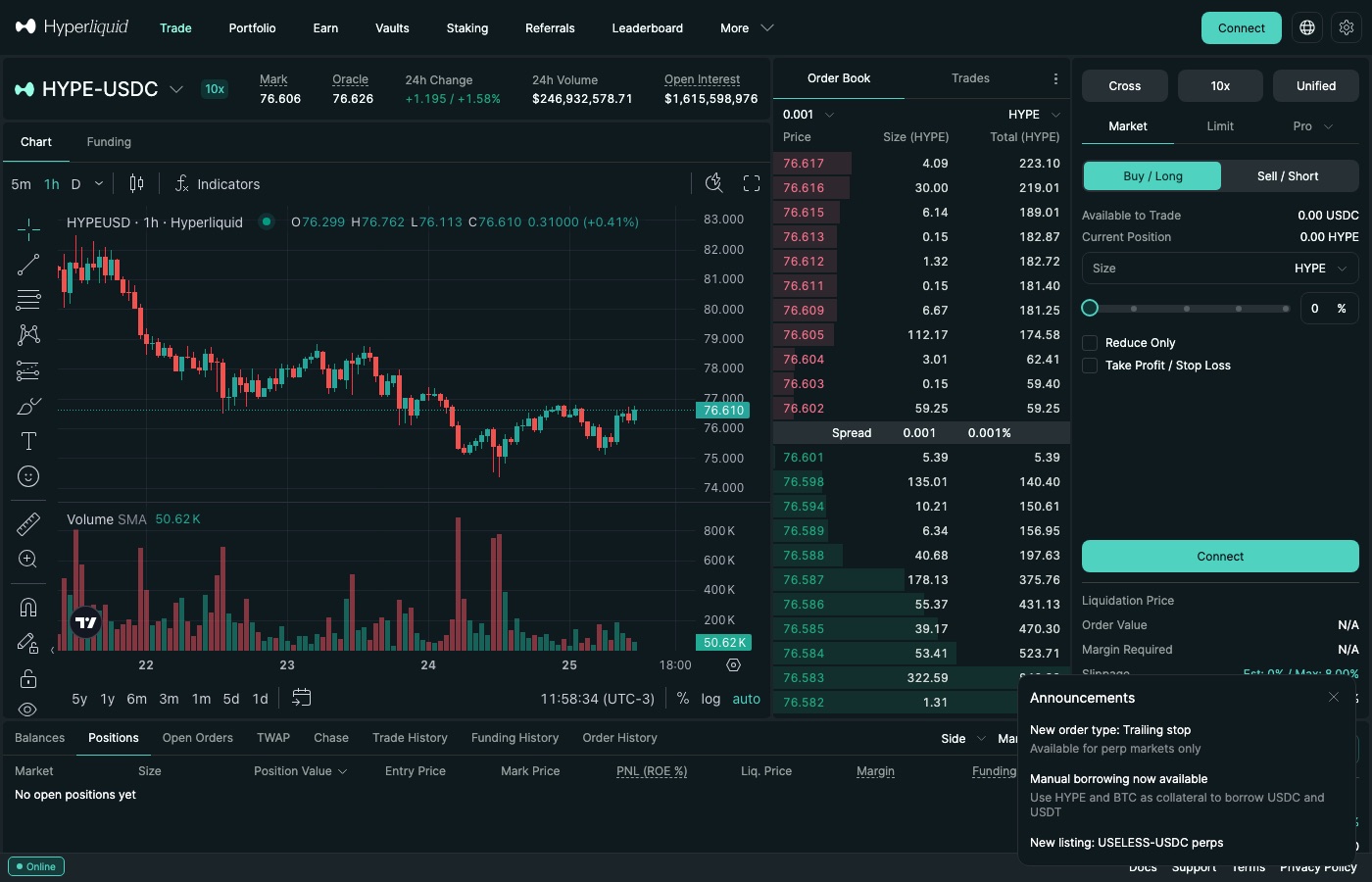
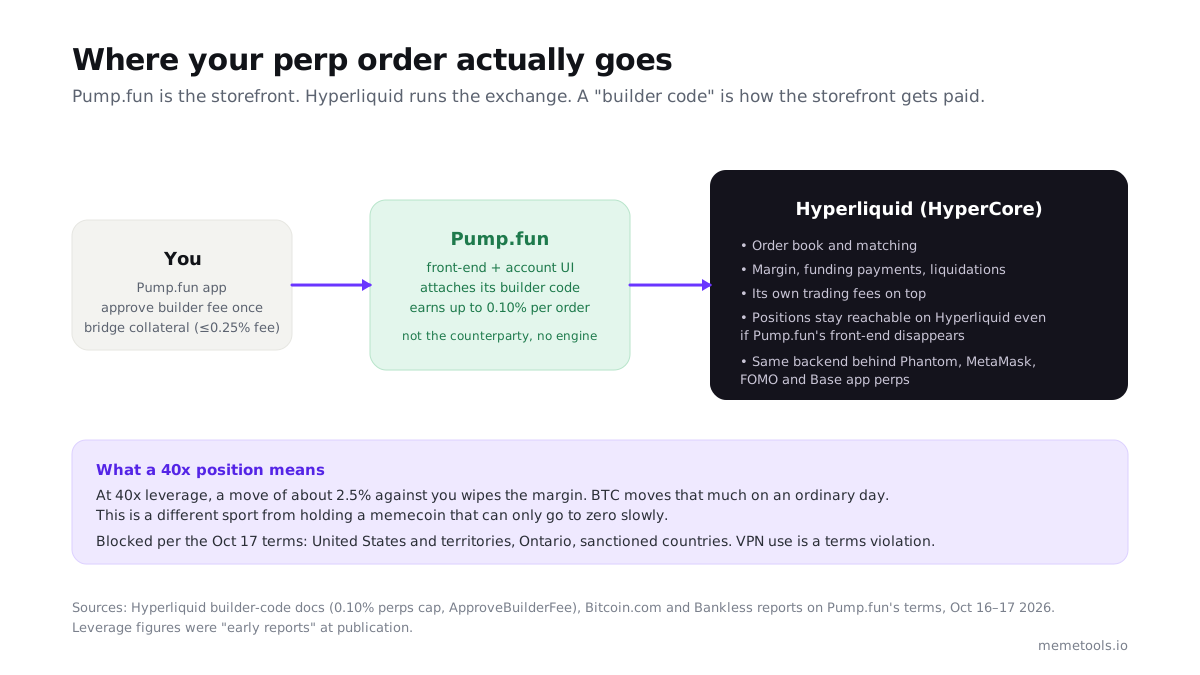
This is the thing to understand before anything else. Pump.fun supplies the screen you tap on. The matching engine, margin accounts, funding payments and liquidations all run on Hyperliquid’s HyperCore. Pump.fun says plainly in its terms that it isn’t the counterparty to your trade and runs no engine of its own.
The plumbing that makes this work is a Hyperliquid feature called builder codes. Any app can route orders to Hyperliquid with its code attached and take a cut. The cap is 0.10% per perp order, charged on both open and close, and the user has to sign a one-time approval of that fee from their main wallet. Reports based on the terms say Pump.fun charges up to that 0.10% maximum. Hyperliquid’s own trading fees sit on top, and moving collateral in costs up to 0.25% in bridge fees.
There are things the public reporting still doesn’t explain. Which wallet actually holds your margin, and how collateral gets from Solana to Hyperliquid, weren’t spelled out anywhere we could find. One analyst noted on October 16 that the evidence of a working product “stops at data”, meaning the endpoint existed but nobody had shown an order going through. Coverage a day later treated it as live. If you plan to use it, test with a small amount and confirm you can withdraw before you do anything else.
Why now
Two reasons, and they’re related. The first is competition. FOMO, a self-custodial trading app that has been eating into memecoin terminal volume all year, added Hyperliquid perps on June 11. On at least one day in September, FOMO out-earned Pump.fun on daily revenue, $1.76 million to $1.1 million. Pump.fun still led comfortably over 30 days, but the direction of travel was obvious. Phantom, MetaMask, Trust Wallet and Coinbase’s Base app all route perps through Hyperliquid too. Not having perps was starting to look like a gap.
The second reason is that Pump.fun has been chasing Hyperliquid on revenue for months and the gap is close enough to be a story. In the last week of September, DefiLlama had Pump.fun at $15.16 million in weekly revenue against Hyperliquid’s $15.06 million. Pump.fun has also had the edge on a 30-day basis at least once, in August, when it posted $35.67 million against $32.46 million.
| DefiLlama snapshot | Pump.fun | Hyperliquid |
|---|---|---|
| Weekly revenue, late Sept | $15.2M | $15.1M |
| 7-day revenue, ~Oct 6 | $18.2M | $14.6M |
| 30-day revenue, ~Oct 6 | $59.0M | $72.4M |
| 30-day revenue, ~Oct 16 | $65.6M | $71.1M |
Two caveats on those numbers. Different outlets pulled DefiLlama on different days and got different figures, so treat them as ranges. And the comparison isn’t like for like: DefiLlama counts only the slice of Hyperliquid fees that flows to its assistance fund, while Pump.fun’s figure includes everything from the bonding curve and PumpSwap. Pump.fun being “ahead” of Hyperliquid is a useful headline and a slightly misleading one.
What it means for the PUMP token
Not much, so far. PUMP traded around $0.0062 in early October, slipped to roughly $0.0046 the day after the perps announcement, and spent the following week near $0.0043. That is about where it was sold in the July 2025 ICO, which raised $500 million in twelve minutes at a $4 billion fully diluted valuation. Half of Pump.fun’s net revenue currently goes to buying back and burning PUMP, and weekly burns have topped $5 million at the peak. A new fee line from perps feeds that, but the market didn’t price it as a big deal.
The part that should give memecoin traders pause
Spot memecoins are brutal, but they fail slowly enough that you can usually get out with something. Leverage doesn’t work like that. At 40x, a move of roughly 2.5% against your position wipes your margin entirely, and Bitcoin moves 2.5% on perfectly ordinary days. The product is being sold to an audience whose main experience is buying a token at $20,000 market cap and hoping. That audience is going to get liquidated a lot.
There is also a dependency problem that applies to every app on this stack. Pump.fun, FOMO, Phantom and the rest all share Hyperliquid’s uptime. When HyperCore has a bad hour, every front-end has the same bad hour at once. The upside of the terms, at least as reported, is that your positions live on Hyperliquid and stay reachable there even if Pump.fun’s front-end goes away.
Who can use it
Not Americans. The October 17 terms block the United States and its territories, Ontario, and sanctioned jurisdictions, and say that using a VPN to get around that is a violation. Pump.fun has been blocking UK users since December 2024 after a warning from the FCA. None of this has drawn public comment from a regulator yet, but a memecoin launchpad offering 40x leverage to retail is the kind of thing that eventually does.
- Perps are not a new version of memecoin trading. They are a different product with a different way of losing money.
- Test deposits and withdrawals with small amounts first. The custody and bridging details were not public when this was written.
- Compare the all-in fee against trading Hyperliquid directly. The builder fee is on top, not instead.
- If you are in a blocked region, the terms say don’t. We agree.